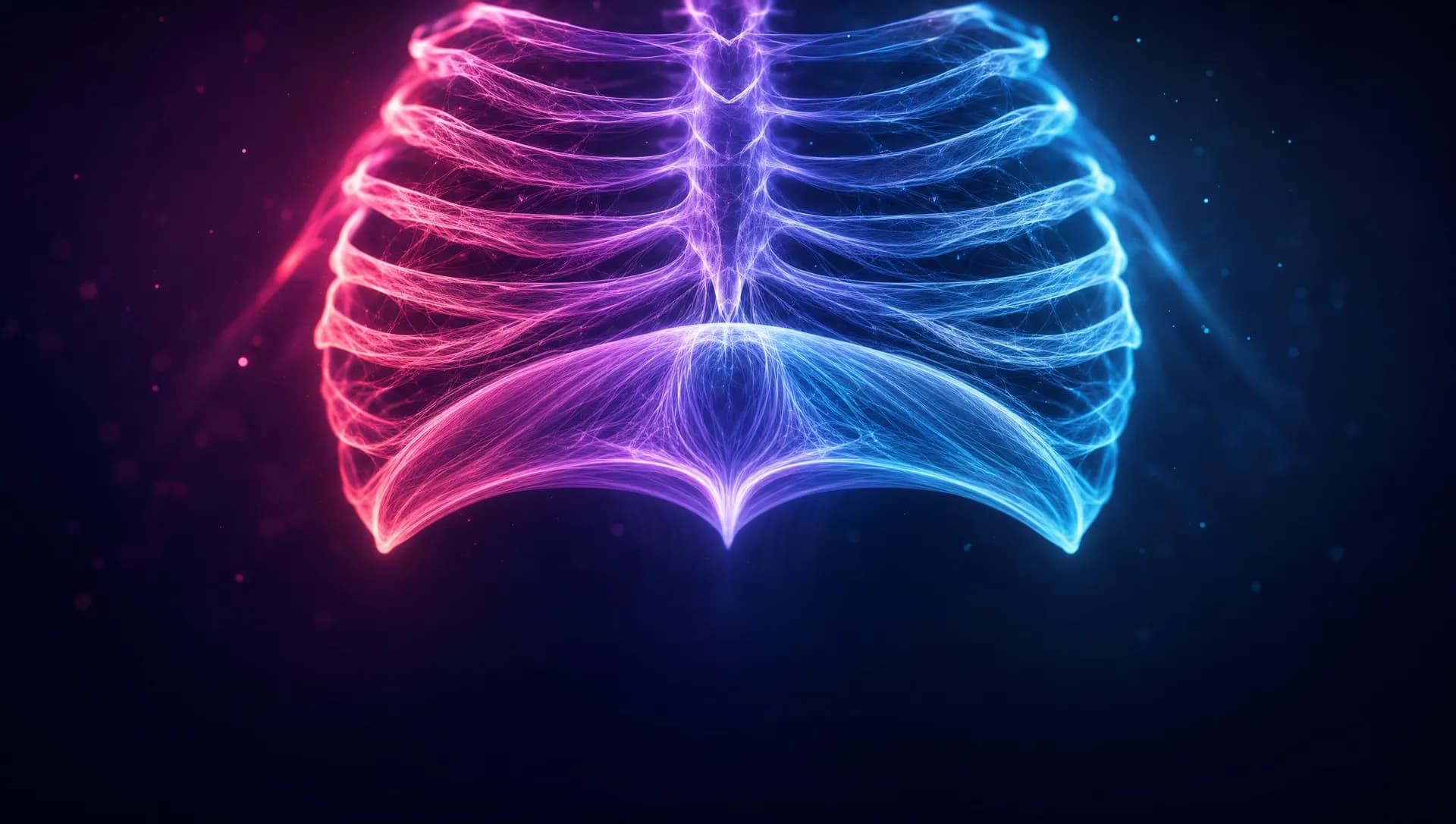

Your Body knows the way forward, and it starts with a breath. How breath, fascia, and your nervous system work together, plus a MicroShift to try today.
You take around 20,000 breaths a day without a thought. That quiet rhythm sets the tone for your posture, your digestion, your focus, and how you meet stress. When breathing has room to move, the rest of the Body follows. When it gets restricted, the effects show up in places you might never link to your ribs or diaphragm: a stiff neck, tight hips, a body that takes forever to warm up in the morning.
Why breath comes first
Breathing is the one automatic function you can also guide on purpose, which makes it a direct way into the Fascia-Nervous System. Your diaphragm, ribcage, neck, low back, and the fascia connecting all of them move together with every inhale and exhale. When that network is guarded, breath turns shallow and effortful. When it has space, your nervous system receives the cue to regulate.
If you have tried the apps, the videos, and the "just breathe" advice and still feel stuck, structure is often the missing piece. Breath needs a Body with room for it. That was the idea behind our Breath Reboot workshop earlier this month.

Inside the Breath Reboot workshop
We spent an afternoon on three practices that work together, each one a tool you can repeat on your own.
Myofascial release stretches. We started with the areas that shape your breath most: the chest, ribs, upper back, and hips. These stretches invite fascia to lengthen and glide, creating space for the ribcage to expand. Many participants noticed their very next breath felt deeper.
Breathing exercises. Next, we trained the diaphragm and ribcage to work as a team. Participants learned to direct breath into the back and sides of the ribs, lengthen the exhale, and use breath as a State Shift when the Body feels wound up.
TRE. We closed with Tension and Trauma Releasing Exercises, a gentle method that encourages the Body to release held tension through natural, rhythmic shaking. TRE helps free the breathing structures from the inside, especially around the hips, pelvis, and diaphragm, where so many of us hold on without realizing it.
What our participants said
One participant shared: "It was great to take an afternoon to really focus on the many breathing tools and stretching and learning how they fit into our well being."
Another described what she felt in her hips: "Through my hips, I felt free! It has felt like a tight rubber band for so long. The next day I got up out of bed and just walked. No stiffness, no feeling like I needed to 'warm up'; I just took off!"
That is resilience in everyday life. When the breathing structures and hips have room to move, mornings get easier, starting with the very first steps out of bed.
Try a MicroShift today
You do not need a full afternoon to begin. Place your hands on your lower ribs and take five slow breaths, letting your ribs widen under your hands on each inhale. Make each exhale a little longer than the inhale. Repeat it a few times today. Small, consistent practice is how your Intelligent Body learns a new baseline.
Make breath part of your Practice
Self-Care as Medicine starts with the tools you can use every day, and breath is the first one. To keep building, join us for Myofascial Stretching, ELDOA and Breathwork, offered Tuesdays at 5:00 PM and Fridays at 12:00 PM, in person and virtual. You can also book a free 30-minute consult with Nikki to talk through where to begin.
A free call with Nikki to find the practice that fits where you are right now.
This is a general educational guide, not medical advice. If a breathing practice ever leaves you lightheaded or uncomfortable, ease off, and a qualified healthcare provider can help you understand what is right for you specifically.